How to Hang Art and Build a Gallery Wall: Heights, Spacing, Layouts
The 57–60 in center rule, the two-thirds rule above sofas and beds, 2–3 in spacing, grid, salon and linear gallery-wall layouts, frames and mats, hardware by weight, picture lighting and rental-friendly hanging.

Key takeaways
- Center art at 57–60 in (145–152 cm) from the floor; drop to 54–56 in in rooms where people sit
- Above furniture, span two-thirds to three-quarters of its width and leave a 6–10 in (15–25 cm) gap
- Space frames 2–3 in (5–8 cm) apart, and hang every frame over 5 lb on two level hooks
- Light art with a fixture half to two-thirds the frame width at 2700–3000K and CRI 90+
Most art is hung too high, too small and too far apart. Fix those three things and almost any room looks more considered without buying another object. This guide covers the hanging height galleries use, the proportion rules above sofas, beds and consoles, spacing between frames, the three gallery-wall layouts that reliably work, frames and mats, hardware by weight, picture lighting and how to do it all without damaging a rented wall, plus framing in bulk for hotels and rental portfolios.
1. The 57–60 inch rule
Galleries and museums hang art so that the center of the piece sits at average eye level, which is 57–60 in (145–152 cm) from the floor. That single number solves the most common mistake in domestic hanging, which is placing art in the upper third of the wall where nobody looks. In a room with a standard 8–9 ft (2.4–2.7 m) ceiling, 57 in (145 cm) is right; with ceilings over 10 ft (3 m), move up to 60 in (152 cm) so the piece does not look pinned to the floor. Where people are mostly seated, in a dining room or a low lounge, drop the center to 54–56 in (137–142 cm).
To find the nail, halve the frame height, add 57 in, then subtract the distance from the top of the frame to the taut wire. For a 30 in (76 cm) frame with the wire 3 in (8 cm) below the top: 15 + 57 − 3 = 69 in (175 cm) from floor to nail. For a gallery wall, apply the rule to the center of the whole group.
2. Above sofas, beds, consoles and mantels
When art hangs over furniture, the furniture overrides the eye-level rule and proportion takes over. Two numbers govern it.
- Width: the two-thirds rule. A piece or grouping above a sofa, bed, console or sideboard should span two-thirds to three-quarters of the furniture width. Above an 84 in (213 cm) sofa, that is 56–63 in (142–160 cm) of art. Anything narrower than half the furniture width looks like an afterthought unless it is deliberately paired with a lamp or object to balance it.
- Height: the 6–10 inch gap. Leave 6–10 in (15–25 cm) between the top of the furniture and the bottom of the frame. Above a sofa back, 8 in (20 cm) is the norm; above a headboard, 6–8 in (15–20 cm) so the art reads as part of the bed composition; above a console or mantel, 4–8 in (10–20 cm) because objects on the surface fill the gap.
| Location | Art width | Gap to bottom of frame | Center height |
|---|---|---|---|
| Open wall, standing room | — | — | 57–60 in (145–152 cm) |
| Open wall, seated room | — | — | 54–56 in (137–142 cm) |
| Above sofa | 2/3–3/4 of sofa width | 6–10 in (15–25 cm) | Set by gap |
| Above bed / headboard | 2/3–3/4 of bed width | 6–8 in (15–20 cm) | Set by gap |
| Above console / sideboard | 2/3–3/4 of console width | 4–8 in (10–20 cm) | Set by gap |
| Above mantel | Not wider than firebox opening plus 12 in | 4–6 in (10–15 cm) | Set by gap |
| Stairwell | Follows the pitch | — | 57–60 in above each tread nosing |
| Hallway gallery | — | — | 57–60 in (145–152 cm) |
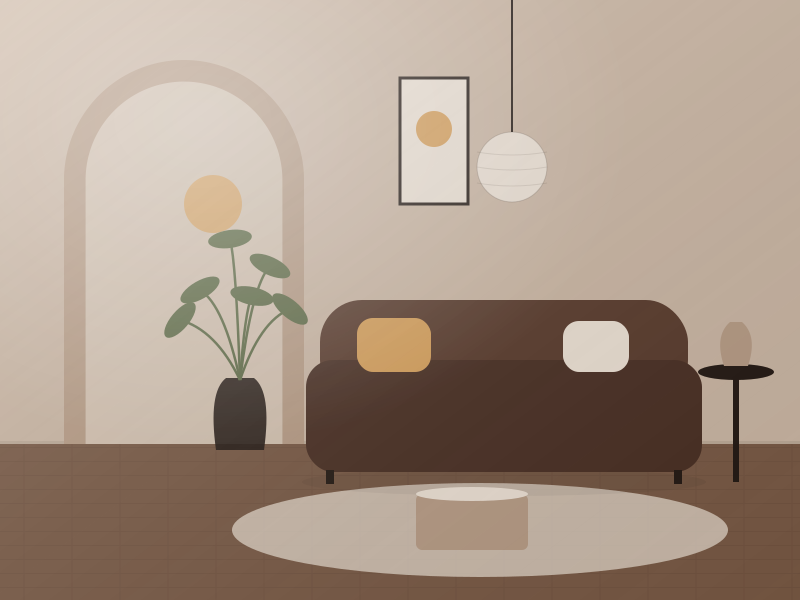
The sofa rule usually produces a center height of 62–66 in (157–168 cm), higher than eye level, and that is correct: the eye reads sofa and art as one unit. The living room trends guide sets out the sofa and rug proportions beneath it.
3. Spacing between frames
Frames in a group should be close enough to read as one composition. Two to three inches (5–8 cm) between edges is the standard; go to 3–4 in (8–10 cm) for frames over 30 in (76 cm) and 1.5–2 in (4–5 cm) for frames under 12 in (30 cm). Keep the gap consistent in a grid; in a salon hang it can vary, but never beyond a third of the smaller adjacent frame.
Treat a pair or triptych as one piece: 2–3 in (5–8 cm) between frames and the whole set centered. Two 24 in (61 cm) frames with a 3 in (8 cm) gap read as 51 in (130 cm) wide, which suits a 72–78 in (183–198 cm) sofa.
4. Gallery wall layouts that work
Three layouts reliably succeed; choose by the art you have and the character of the room.
The grid
Identical frames, identical mats, equal spacing: two rows of three, three by three, or two by four. The grid suits a series of photographs, botanical prints or studies. Use frames of 16 × 20 in (40 × 50 cm) or larger with 2–3 in (5–8 cm) gaps and center the block at 57–60 in (145–152 cm). It is the easiest hang to get right and suits hotels, where one module can be specified once and hung in fifty rooms.
The salon hang
Mixed sizes and frames filling a wall from wainscot to near the ceiling. The trick is an invisible structure: place one large anchor piece slightly off center at eye level, build outward, and keep the outer edges roughly aligned to an imaginary rectangle. Repeat two or three frame finishes and one mat color so the variety holds together. Trace every frame on kraft paper, tape the templates up and live with them for two days before you drill.
The linear hang
A single row aligned on centers at 57–60 in (145–152 cm), or along the top or bottom edge. A center-line hang tolerates mixed sizes; an edge-aligned hang wants matching frames. Linear suits hallways, staircases following the pitch and long consoles, with spacing opening to 4–6 in (10–15 cm) on a long wall. Read our entryway design ideas for how a linear hang makes a narrow hall feel like a gallery.
Two hybrids also earn a place: the ledge hang, with frames leaning on 4 in (10 cm) deep picture ledges at 54 and 66 in (137 and 168 cm), and the anchored asymmetric hang, one large piece with two or three small ones stepped off a corner, which suits a console wall where a full gallery would be too much.
5. Frames and mats
The frame is a bigger design decision than the art in most rooms, because there is more of it. The 2027 direction is warm and quiet: natural oak, ash and walnut, thin brass and bronze metal, and off-black rather than jet. Thin gallery frames of 0.5–0.75 in (12–20 mm) suit photography and modern work; 1.5–2.5 in (40–60 mm) profiles carry older prints and paintings. Float mounting, with a shadow gap around the sheet, is now the default for works on paper.
Mats do two jobs: they give the work breathing space and they scale a small piece up to a frame that reads on the wall. A mat of 2–3 in (5–8 cm) on a print up to 11 × 14 in (28 × 36 cm) and 3–4 in (8–10 cm) on a print up to 16 × 20 in (40 × 50 cm) is the classic proportion; a slightly wider bottom margin, by 0.5 in (1 cm), corrects the optical sinking of a centered image. Choose acid-free, conservation-grade board, and warm white or off-white rather than pure white, which fights with most walls and paper stocks. Ask for glazing with UV protection for anything you care about, and anti-reflective glazing for a piece facing a window; acrylic is lighter and safer above a bed.
#E6DCCD#CDBBA3#7B2E2B#7D8B6A#3A2E27When mixing frames on one wall, limit the palette to two or three finishes and let one dominate. Two-thirds oak with one-third off-black is a reliable ratio. The mixing metals guide applies the same logic to brass and bronze frames alongside lighting hardware, and the 2027 color palettes article helps you pick a mat and frame tone that agrees with the wall.
6. Hardware and weights
Match hardware to frame weight and wall construction. A bathroom scale is accurate enough; a knuckle rap tells you hollow drywall from solid masonry.
| Frame weight | Drywall / plasterboard | Masonry / concrete | Frame fitting |
|---|---|---|---|
| Up to 5 lb (2 kg) | Adhesive strips or a single picture hook nail | Single picture hook nail | Sawtooth hanger |
| 5–20 lb (2–9 kg) | Two-nail picture hook or self-drilling drywall anchor | Masonry nail or 6 mm plug and screw | D-rings and wire, or two D-rings level |
| 20–50 lb (9–23 kg) | Two toggle bolts or fixings into a stud | Two 6–8 mm plugs and screws | Two D-rings hung on two hooks |
| 50–100 lb (23–45 kg) | Fixings into studs only, or a horizontal batten | Two 8–10 mm plugs, or a rail system | Heavy-duty hangers or cleat |
| Over 100 lb (45 kg) or mirrors | Studs plus a french cleat, ideally professional install | Steel cleat with 10 mm anchors | French cleat or Z-bar |
Two hooks always beat one: the frame stays level and the load is halved. Fix D-rings a third of the way down each side and hang them directly on two level hooks rather than on a wire, which lets the frame swing. Over 20 lb (9 kg) on drywall, find the stud or use a toggle. Never rely on a single adhesive strip above a bed, and never hang a mirror by wire on a nail.
7. Lighting art
A picture light turns a print into the focal point of the room. Use a fixture half to two-thirds the frame width, mounted 4–6 in (10–15 cm) above the frame or on it, angled at 30–35 degrees so the light rakes the surface without glare; a 30 in (76 cm) picture wants a 16–20 in (40–50 cm) light. Rechargeable LED picture lights now run 60–100 hours per charge, which solves the wiring problem in a rental.
Specify 2700K for warm interiors or 3000K where the art is cool-toned, and CRI 90 or above, ideally 95, so reds and greens are not deadened; CRI 80 picture lights are why so many hung works look flat. Aim for the art to be two to three times brighter than the surrounding wall, usually 150–300 lux on the surface. Ceiling-mounted adjustable spots aimed at 30 degrees do the same for larger works; set the fixture back from the wall by about half its height above the art center. Our how to layer lighting guide places picture lights within the wider scheme, and the lighting calculator gives the room total.
8. Rental-friendly hanging
If you cannot make holes, or can make only a few, you still have options that look like a permanent hang.
- Adhesive strips: rated by the pair, typically 4 lb (1.8 kg) per pair for the medium size and up to 16 lb (7 kg) for the large. Press for 30 seconds, wait an hour before hanging, and stick only to painted smooth walls, never to wallpaper, textured plaster or fresh paint under three weeks old.
- Picture rail systems: a slim aluminum or brass rail fixed at the ceiling or cornice with a handful of screws, and steel or nylon cords with sliding hooks. One row of fixings supports a whole wall of art you can rearrange indefinitely; landlords are usually happy with it.
- Picture ledges: two or three screws per 36–48 in (91–122 cm) ledge, and leaning frames that need no hooks at all.
- Lean it: a piece 36–48 in (91–122 cm) tall standing on a console or the floor is the most relaxed 2027 hang and needs only a non-slip pad.
- Fill and paint: if you do drill, keep filler and 8 fl oz (250 ml) of the wall color; each hole takes two minutes to erase at move-out.
Short-term rental hosts face the reverse problem: art must survive guests and cleaners. Use acrylic glazing, two fixings per frame and security hangers near beds; the short-term rental design guide has the details.
9. Framing in bulk for hospitality and rental portfolios
For a hotel of 80 rooms or a portfolio of 20 apartments, framing stops being decoration and becomes procurement. Specify a small number of modules, say two sizes such as 20 × 28 in (50 × 70 cm) and 28 × 40 in (70 × 100 cm), one frame profile in one or two finishes, acrylic glazing, sealed backs and security hanging hardware, and have the art printed and framed together. Frame factories in China and Vietnam produce custom-profile solid-wood or MDF-wrap frames with MOQs from roughly 50–100 pieces per size and finish, at FOB prices in the 8–25 USD band for a glazed 20 × 28 in frame depending on moulding, glazing and backing; framed giclée prints with hanging hardware add 10–30 USD each in that volume. Lead times run 30–45 days plus shipping.
Ask for a sample frame with the exact moulding, corner join and glazing before confirming, and specify corner protectors and individual cartons; 5 percent breakage is normal on a cheap framing order and 1 percent is achievable with proper packing. The hotel FF&E sourcing guide explains how to fold framing into the wider FF&E schedule, and how to source furniture from China covers inspection and payment terms.
If you would like a wall laid out to scale before you drill, our online design service produces a dimensioned elevation from your frame sizes and a photo of the wall, and the sourcing desk can quote frames, mirrors and framed prints for projects of any size. For the vocabulary, from float mount to French cleat, see the glossary.
Free toolWallpaper CalculatorHow many rolls you need, allowing for the pattern repeat.Shop & source the look
Buy it today — or have it made
Retail links are affiliate links: we may earn a commission at no extra cost to you (disclosure). “Get it made” sends the item to our sourcing desk for factory quotes in custom sizes and finishes.
Frequently asked questions
What height should you hang pictures?
Hang art so its center is 57–60 in (145–152 cm) from the floor, which is average eye level. Above a sofa or bed, ignore that rule and leave 6–10 in (15–25 cm) between the furniture and the bottom of the frame.
How big should art be above a sofa?
The piece or group should span two-thirds to three-quarters of the sofa width. Above an 84 in (213 cm) sofa, aim for 56–63 in (142–160 cm) of art, hung 8 in (20 cm) above the sofa back.
How far apart should pictures be on a gallery wall?
Leave 2–3 in (5–8 cm) between frame edges, tightening to 1.5–2 in for small frames and opening to 3–4 in for frames over 30 in. Keep the gap consistent in a grid and center the whole group at 57–60 in.
How do you hang heavy art without damaging the wall?
Use two fixings rather than one. On drywall, fix into a stud or use toggle bolts for anything over 20 lb (9 kg); on masonry use plugs and screws. Frames over 50 lb (23 kg) or mirrors should hang on a French cleat.
Some links may be affiliate links. Regulations and specifications change — always confirm with suppliers and qualified professionals.